Orange Casey Strikes Out!
Click on Title to Read

Trumpety’s prime-time address Thursday night presented newly declassified intelligence, claiming it was powerful evidence of deep vulnerabilities and foreign interference in American elections; and especially that nefarious Chicom operatives had corrupted the 2020 election outcome.
Accordingly, the speech urged immediate passage of the SAVE America Act and portrayed the current system as dangerously exposed to cheating and large-scale, election-swaying fraud.
Alas, the Donald’s claims were again not nearly what they were cracked up to be. Indeed, a close examination of this newly released “evidence”, combined with the actual results of the 2020 election, leads to a very different conclusion: Namely, that there is no there there!
That is, there is no documented chain connecting this newly declassified material to even a single altered vote in the six states that decided the 306-232 outcome in the Electoral College.
1. The 2020 Election Was a Mess — Driven by Pandemic Chaos and Last-Minute Rule Changes
The 2020 presidential election took place under conditions unlike any in modern American history. The COVID-19 pandemic, widespread lockdowns, and false public fear generated by Dr Fauci & Co. produced a sudden and massive expansion of early and mail-in voting. States also altered rules at the eleventh hour, extended deadlines, relaxed verification standards, and in some cases accepted ballots with minimal identification or signature checks.
These changes were falsely defended as necessary public-health measures, but they created administrative confusion, strained local election offices, and opened the door to legitimate questions about consistency and chain of custody.
For most of the period since 2000, the large majority of Americans voted in person on Election Day. In 2016, roughly 55 percent of voters cast ballots at polling places on Election Day itself, according to federal data. In earlier cycles the share was often higher, typically in the 60 percent range or above even as some states gradually expanded early voting options.
In 2020, however, the picture changed dramatically. Only about 30.5 percent of voters cast ballots in person on Election Day.
In defiance of all prior history and practice, more than two-thirds of Americans voted early in person or by mail. This was not a slow evolution. It was an abrupt, pandemic-driven transformation that shifted the balance of voting methods more sharply than at any time in recent decades, if ever.
The result was record turnout combined with unprecedented delays in counting, a flood of last-minute legal challenges, and widespread public unease about the process.While these disruptions do not prove widespread fraud per se, they explain why the election felt chaotic to millions of Americans and why confidence in the outcome fractured along partisan lines.
2. The Election Was Extremely Close in the Six Swing States — and Comfortably Won Elsewhere
Despite the chaos, the certified results show that the decisive margin was narrow and concentrated in a handful of states. In fact, here are the 79 Electoral College votes that determined the outcome and the razor thin margins by which they ended up in the Biden column.
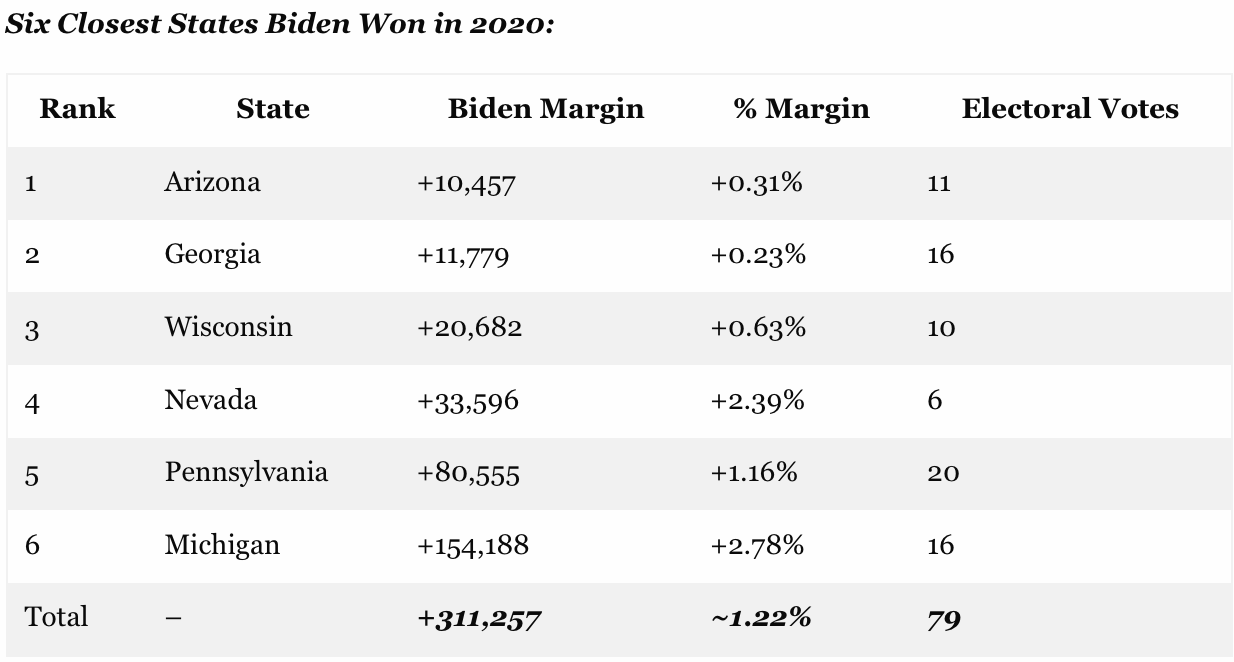
These six states together accounted for roughly 25.54 million votes. Biden’s combined margin was 311,257 votes — about 1.22 percent.
Nationally, approximately 158.38 million votes were cast. Biden’s overall popular-vote margin was roughly 7.05 million votes, or about 4.45 percent. When the six swing states are removed, moreover, Biden’s margin in the rest of the country was approximately 6.74 million votes, or a quote comfortable 5.07 percent.
In short, Biden won the rest of America by a solid margin. Overturning the result through fraud outside these six states would have required an operation of enormous scale with no historical precedent.
So the election facts are clear: The one and only realistic path to changing the 2020 Electoral College outcome ran through these six states and their combined 311,257 vote margin.
3. The New Disclosures Contain No Direct Link to Voting in the Six Swing States
The material released alongside Trump’s address highlighted several categories of concern:
China’s compromise of roughly 220 million voter registration records.
The general technical capabilities of foreign adversaries to target election systems.
A Venezuelan regime’s development of techniques for manipulating electronic voting.
A national estimate of non-citizens on voter rolls.
Yes, these are serious election security issues. They do not, however, demonstrate that any votes were changed in Arizona, Georgia, Wisconsin, Pennsylvania, Nevada, or Michigan.
For instance, China did obtain extensive registration data. The declassified documents describe collection and analysis for intelligence purposes. But they do not show in any way, shape or form that this data was used to register fraudulent voters or to alter ballots that were actually cast.
That is to say, data theft is not the same thing as vote manipulation, and no forensic connection appears in the released material to the specific margins in the six swing states.
The Venezuelan example is even further removed. It describes capabilities developed inside an hideously corrupt authoritarian regime for its own elections. There is no evidence in the disclosures that these techniques were transferred to or successfully executed within the United States’ decentralized system of fifty states and thousands of local jurisdictions.
Stated differently, capabilities in a country 2,000 miles from Washington DC to meddle in an election process are not the same as successful execution on the ground in more than 3,000 US counties. One cannot prove fraud by inference alone:
The fact that China held registration files does not prove those files were used to change outcomes.
The fact that Venezuela developed certain manipulation methods does not prove those methods were inserted into American elections in specific states, counties and precincts.
The only rigorous way to demonstrate that the 2020 result was stolen is to show, with evidence, how the exceedingly narrow certified margins in the six states were owing to a sufficient number of corrupted votes so as to alter the outcome. The new declassified disclosures do not do remotely accomplish that task.
4. Extensive Audits and Investigations in the Swing States Found No Outcome-Changing Fraud
The six swing states were subjected to an extraordinary level of post-election scrutiny. Multiple recounts, hand audits, forensic examinations, legislative investigations, and court cases examined the results in detail. Despite intense partisan pressure and public claims of widespread fraud, none of these reviews produced evidence of enough altered or fraudulent votes to change the outcome in any of the states.
In Arizona, the Republican-controlled Senate commissioned the Cyber Ninjas audit of Maricopa County. The review was highly critical of some election procedures and found discrepancies in ballot images and voter rolls. Nevertheless, after examining ballots and data, it ultimately confirmed that Joe Biden had won the state by a margin consistent with the certified results.
Georgia conducted multiple statewide recounts, including a full hand recount of all ballots. State officials, including Republican Secretary of State Brad Raffensperger, oversaw repeated audits and investigations. While some procedural issues and small numbers of irregularities were identified, none approached the scale needed to overcome Biden’s 11,779-vote margin.
Wisconsin saw legislative audits and reviews by Republican lawmakers. These examinations uncovered problems with absentee ballot handling in certain localities and raised questions about the use of drop boxes. Again, the irregularities documented fell far short of the 20,682-vote margin.
Pennsylvania faced dozens of lawsuits and reviews. Courts, including those with Trump-appointed judges, examined claims of fraud and procedural violations. While some mail-ballot practices were criticized, no evidence emerged of systematic fraud sufficient to flip the state’s 80,555-vote margin.
Michigan and Nevada underwent similar processes. Legislative reviews, canvassing board examinations, and court challenges all failed to uncover enough invalid or fraudulent ballots to alter the certified results.
Taken together, these investigations represent one of the most intensive post-election examinations in American history. They found real problems — sloppy procedures, inconsistent rules, and occasional instances of fraud or error.
However, they did not find evidence that these problems were large enough, coordinated enough, or concentrated enough to change the outcome in any of the six states.
Nevertheless, a Federalist caveat is worth stating plainly here. The U.S. Constitution leaves the “Times, Places and Manner” of holding elections primarily to the states, with Congress given only limited power to override.
This was a deliberate design choice by the Founders. They understood that centralized control of elections would invite constant national litigation and power struggles in the nation’s capital. If every close (or even strong) election becomes subject to federal second-guessing and nationwide legal warfare, we risk turning the entire process into a permanent battle among lawyers, bureaucrats, and national political elites.
Indeed, Republican election reformers need to remember that there can be such a thing as Democrat landslides like the elections of 1936 and 1964. Do we really want every future decisive victory — whether by Democrats or Republicans — turned into years of federal court battles and congressional investigations that ultimately empower Washington insiders rather than voters and state officials?
Keeping elections decentralized, with primary authority at the state and local level, remains the wiser constitutional arrangement.
5. The SAVE America Act Contains Valuable Reforms — But It Would Not Have Changed 2020
The SAVE America Act includes several provisions that would strengthen future elections. Requiring photo identification and documentary proof of citizenship for registration are reasonable safeguards that command strong public support and shouldn’t even be debatable.
Likewise, improved auditing standards and clearer chain-of-custody rules for mail ballots would also help restore confidence, as would restricting mail-in voting to narrowly defined cases of voter unavailability on Election Day due to necessary travel, illness or other self-evident hardships.
These reforms deserve serious consideration on their own merits.–ideally on a state by state basis. They address real vulnerabilities and would likely improve the integrity and perceived fairness of future elections.They would not, however, have changed the outcome of the 2020 election!
The certified results in the six swing states withstood repeated recounts, hand audits, forensic reviews, and court challenges. No evidence emerged that the narrow margins were the product of coordinated, outcome-determinative fraud on the scale required.
At the end of the day, the Donald’s July 16 speech was just another exercise in Trumpian bombast, partisanship, and selective use of facts. And its nesting in his “Golden Age” narrative does not remotely hold up under scrutiny, as we have demonstrated over and over.
In fact, the U.S. economy in mid-2026 is showing clear signs of renewed inflationary pressure, with very little genuine broad-based growth or job creation outside the concentrated boom in AI-related capital spending and the ongoing Wall Street asset bubble.
At the same time, the unnecessary and utterly unjustified military attack on Iran has ended in strategic failure, with no durable gains to show for the $100 billion of military expenses already incurred, to say nothing of the trillions worth of dislocation and disruptions now coursing through the global economy—-a tidal wave of economic destruction that has not yet crested as full-on warfare and competing embargoes in the Persian Gulf renew.
In short, the Donald has already struck out on the matter of the Affordability Crisis at home, upon which he fluked into office the second time, and on the catastrophic failure of his war against Iran. So he was apparently, trying to hit one out of the park Thursday night in order to reverse the tide.
He did not. Like Casey at the Bat, he swung and missed by a country mile.
In the game of baseball, of course, three strikes and you are out. And that’s exactly where the POTUS ended up as the teleprompter scrolled to the end of an utterly vacuous string of Trumpian boasts, bombast, baloney and belligerence.